VB-America.com
30 September, 2025
völkischerbeobachter.com
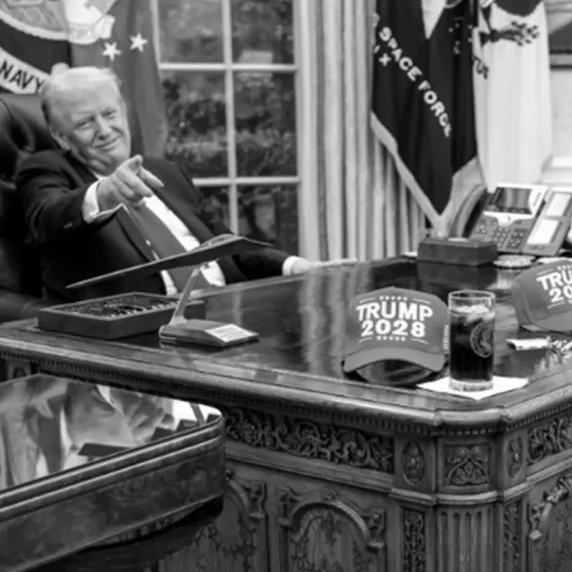
Trump hints at seeking third term without election
Washington, D.C. – 30 September, 2025 - President Donald J. Trump has recently stoked debate and alarm by publicly asserting that he believes there are “methods” by which he could remain in power beyond 2028, even though the U.S. Constitution imposes explicit limits on presidential terms.
In a March 30 interview with NBC’s Kristen Welker, the president declined to rule out the possibility of a third term, saying, “There are methods which you could do it … that’s one,” when asked whether Vice President J.D. Vance might run in 2028 and then hand over the presidency. He added, “But there are others, too.”
Trump’s remarks immediately revived speculation among legal scholars and political commentators about conceivable—but highly controversial—pathways around the constitutional prohibition. The 22nd Amendment, ratified in 1951, states plainly that “no person shall be elected to the office of the President more than twice,” and further limits those who assume an unexpired term to serving more than two years to being elected only once.
Many constitutional experts and fact-checking organizations quickly dismissed the notion of a legal loophole as implausible. They argue Trump’s statements misinterpret or ignore the clear intent of the amendment. For example, FactCheck.org described his suggestion as “implausible” and inconsistent with a proper reading of both the 22nd and 12th Amendments. Under the 12th Amendment, a person who is constitutionally ineligible to be president would also be ineligible to serve as vice president—undermining the idea of a vice-presidential “backdoor” route.
To overcome these barriers, critics say, Trump would have to propose an amendment to repeal or alter the 22nd Amendment—a daunting prospect requiring a two-thirds majority in both houses of Congress and ratification by three-quarters of the states.
Some of Trump’s closest allies, however, have not shrunk from amplifying rhetoric about a third term. Influential voices in the MAGA movement have publicly argued that Trump will return in 2028. Former strategist Steve Bannon, for instance, has spoken of grand plans to “make this revolution permanent” and backed the idea that Trump’s role might endure beyond two terms. (Le Monde.fr) Senator Lindsey Graham also voiced support for Trump running in 2028, despite the constitutional constraints.
Yet within Republican ranks, the idea is far from universally accepted. Oklahoma Senator Markwayne Mullin, for example, said he would not back any attempt to override the Constitution unless explicitly endorsed by “the American people.”
The wider political stakes are substantial. If Trump seriously pursues a third term, it would provoke an epochal constitutional crisis, bringing into collision the rule of law, separation of powers, and public trust. The debate is no longer purely hypothetical, and it has already become a lightning rod for warnings that democracy itself may be tested.
Key Facts & Legal Hurdles
22nd Amendment prohibition.
Bars any person elected president twice from being elected again, and limits eligibility in certain succession cases.
12th Amendment compatibility.
Treats eligibility for vice president as tied to eligibility for president, blocking schemes that would place an ineligible individual in succession.
“Methods” theory.
Trump’s vague references to possible routes—such as vice-presidential ascension—have been broadly rejected by legal scholars.
Constitutional amendment path.
Repealing or altering the 22nd would require supermajorities in Congress and ratification by states—an extremely high bar.
At present, the prevailing consensus among constitutional authorities is that despite President Trump’s provocative rhetoric, any attempt to remain in power past 2028 without adhering to the constitutional constraints would face near-certain court challenges and political resistance.
Source URLs
https://www.politico.com/news/2025/03/30/trump-wont-rule-out-running-again-in-2028-00259952
https://www.washingtonpost.com/politics/2025/03/31/trump-third-term-22nd-amendment-us-constitution/
https://en.wikipedia.org/wiki/Twenty-second_Amendment_to_the_United_States_Constitution
https://www.theguardian.com/us-news/2025/feb/23/markwayne-mullin-trump-third-term-constitution

Hitler secures total control
Berlin, 1934 — Adolf Hitler’s rise from chancellor in 1933 to absolute dictator within a few short years remains one of the most dramatic examples of democratic institutions being dismantled from within. His consolidation of power unfolded through a combination of legal manipulation, propaganda, intimidation, and outright violence.
The process accelerated after the Reichstag fire in February 1933, which Hitler blamed on Communists. The crisis provided him with the pretext to push through the Reichstag Fire Decree, suspending basic civil liberties such as freedom of speech, assembly, and the press. Mass arrests of political opponents followed, weakening any organized resistance.
Just weeks later, the Reichstag passed the Enabling Act of March 1933, which effectively transferred legislative power to Hitler’s cabinet. With this law, Hitler could enact policies without parliamentary approval or presidential oversight. Although presented as a temporary emergency measure, it became the cornerstone of his dictatorship.
The Nazi regime then embarked on a systematic program of Gleichschaltung, or “coordination,” eliminating independent labor unions, political parties, and state governments. By July 1933, the Nazi Party had become the only legal political organization in Germany. Elections thereafter were stage-managed exercises, offering only Nazi-approved candidates.
President Paul von Hindenburg’s death in August 1934 allowed Hitler to merge the offices of president and chancellor, declaring himself Führer. A carefully orchestrated plebiscite, carried out under conditions of fear and propaganda, confirmed the move. From then on, Germany ceased to function as a democracy: parliament became ceremonial, elections meaningless, and dissent a crime punishable by imprisonment or worse.
Hitler’s methodical dismantling of democratic safeguards illustrates how authoritarian regimes can emerge from legal and constitutional frameworks when checks and balances are weakened, and when fear overrides free choice. By eliminating competitive elections, he secured total control—setting the stage for war and genocide.
Source URLs
https://encyclopedia.ushmm.org/content/en/article/the-reichstag-fire
https://www.britannica.com/event/Enabling-Act-Germany-1933
https://www.britannica.com/event/Gleichschaltung
https://www.ushmm.org/collections/bibliography/hitlers-rise-to-power